Portugal vs Spain Holiday Let Investment: Which Destination Should You Analyse First?
Important note
This article is educational only. It is not legal, tax, mortgage, planning, valuation, financial, immigration or investment advice. The figures below are illustrative assumptions used to show a comparison workflow. They are not forecasts, predictions, recommendations or claims that a property in Portugal or Spain will perform in this way.
Property ownership alone does not provide Portuguese or Spanish citizenship, EU passport rights, residency or immigration status. Residency and citizenship rules change over time. Anyone considering immigration, residency or citizenship should obtain specialist advice from appropriately qualified professionals.
Introduction
Portugal and Spain are often compared by lifestyle, but lifestyle is the wrong starting point for a holiday-let investment decision.
A buyer can prefer Portugal’s Atlantic coastline and villa resorts. Another buyer can prefer Spain’s Mediterranean apartment markets. Neither preference proves that the numbers, evidence and operating model are strong enough to support an offer.
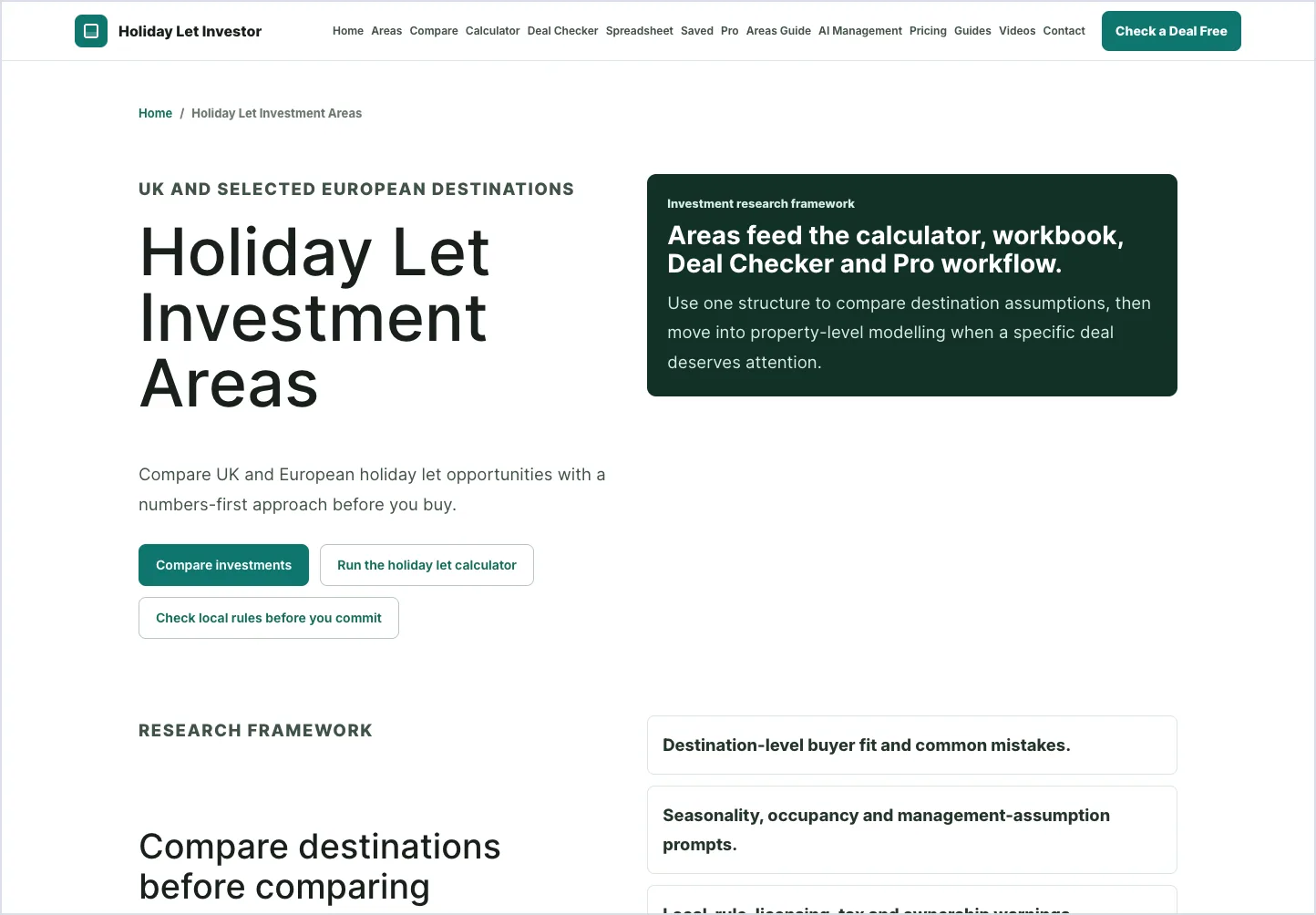
Holiday Let Investor is an investment platform, not a travel blog. The purpose is not to choose a winner. It is to show how an investor can compare two destinations using the same discipline.
The comparison follows the Holiday Let Investor workflow:
Research -> Areas -> Holiday Let Calculator -> Deal Checker -> Investment Comparison Engine -> Property Report -> Holiday Let Investment Spreadsheet -> Pro -> AI Investment Intelligence.
The worked numbers are illustrative. The method is the point: compare destinations, keep assumptions visible, stress-test the model and record evidence gaps.
Key takeaways
- Portugal vs Spain is not a "best country" question. It is an assumptions, evidence and operating-risk comparison.
- Portugal may lead a buyer toward villa, pool, golf, marina-town and village-market assumptions.
- Spain may lead a buyer toward apartment, villa, Mediterranean resort, marina-development and community-ownership assumptions.
- The same euro purchase price can produce different operating risks because property type, management route, community rules and seasonality differ.
- This comparison uses a 50% deposit self-managed scenario with paid local support. It avoids the repeated 25% deposit, 75% loan-to-value and full-management pattern.
- Property ownership alone does not create Portuguese or Spanish citizenship, EU passport rights, residency or immigration status.
- Do not rely on lifestyle appeal, headline rent or a single forecast without checking rules, management, comparable demand and downside resilience.
Watch the full walkthrough
Portugal investment profile
Portugal holiday-let analysis often starts with the villa story: outside space, pool, golf access, coastal drives, marina towns and villages. That shapes guest profile, owner-use assumptions and property type. It does not prove the investment case.
For a Portugal villa, the buyer should test whether the story is backed by monthly booking demand, comparable villa evidence, local management coverage, pool and garden costs, local accommodation evidence and currency sensitivity.
The model should separate the owner’s strategic role from cleaning, guest response, call-outs, pool servicing and local administration.

Spain investment profile
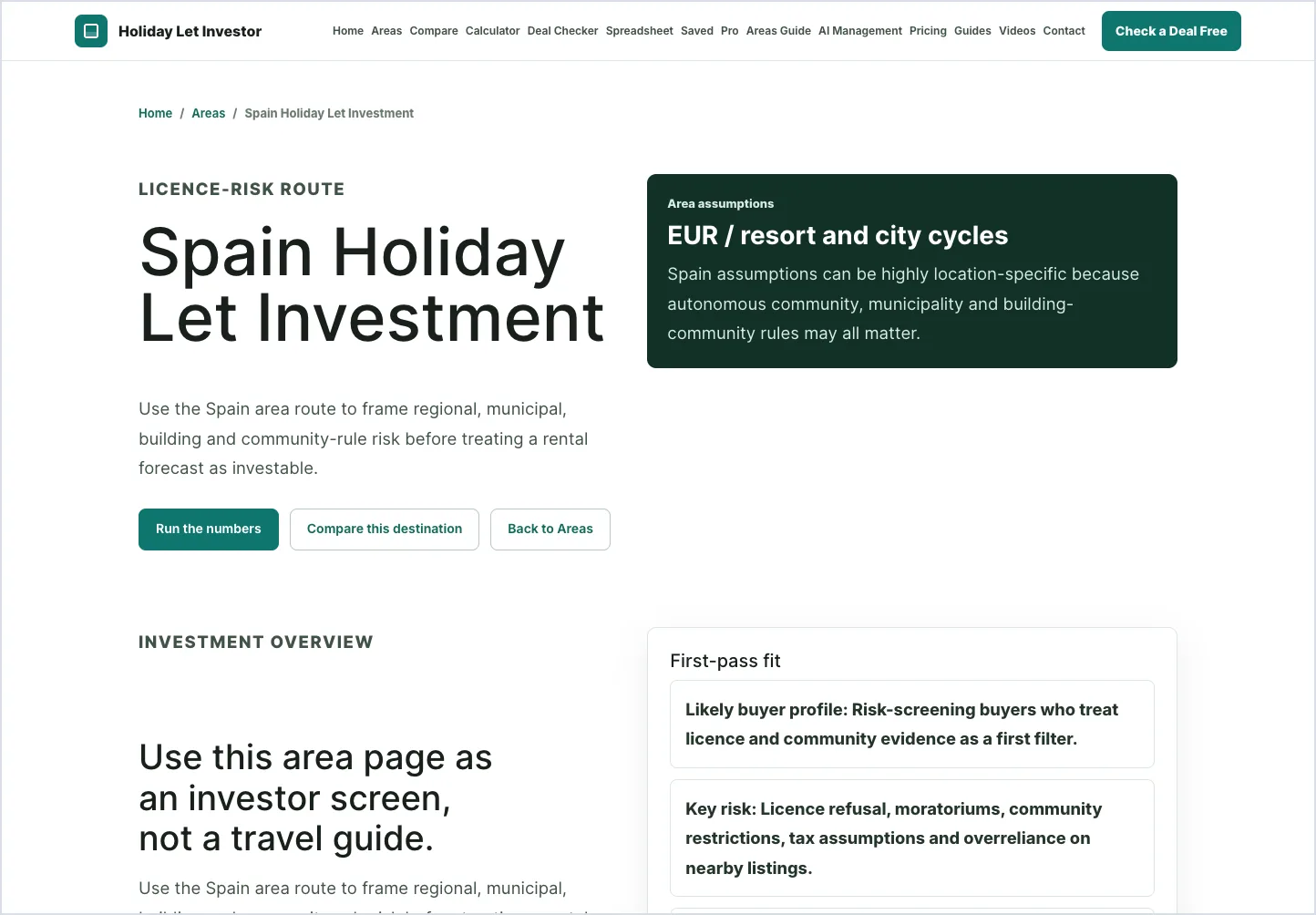
Spain can produce a different investment question. In many searches, Spain means apartments, villas, resort communities, marina developments and established international demand. Apartment ownership may introduce community fees, building rules, tourist-let restrictions and shared-facility obligations.
Spain should not be treated as a cheaper or simpler version of Portugal. Property type, community rules, local management and seasonality can all change the model.
Lifestyle considerations
Lifestyle can be part of the investment story, but it should not lead the model. Portugal may suit buyers who value villa space, pool, golf access and Atlantic coastline. Spain may suit buyers comparing apartments, marina developments, walkable resort areas and community facilities. Those profiles are illustrative, not recommendations.
The stronger question is: what lifestyle assumptions are being monetised, and what evidence supports them?
Accessibility
Access affects both guest demand and owner practicality. For Portugal, test flight routes, drive time, golf or marina demand and owner visit practicality. For Spain, test air routes, resort transfer, car-hire reliance, building access, parking and check-in logistics.
If the buyer relies on shoulder-season demand, flight frequency and guest access become more important.
Typical buyer
This comparison may suit illustrative buyer profiles such as:
- a UK buyer comparing a Portugal villa with a Spain apartment before choosing a search area;
- a lifestyle buyer who wants family use but still needs an evidence-led investment model;
- a remote owner who needs paid local cleaning and maintenance support;
- a buyer who wants to compare euro-denominated opportunities against UK worked examples;
- a portfolio-minded investor using the same assumptions across multiple destinations.
These are examples only, not recommendations to buy in either country.
Property types
The property type changes the model before the spreadsheet opens. A Portugal villa and a Spain apartment are not operationally identical.
| Item | Portugal illustrative property | Spain illustrative property | Why it matters |
|---|---|---|---|
| Property type | Villa with pool | Two-bedroom coastal apartment | Different maintenance and guest profile |
| Asking price | EUR 475,000 | EUR 325,000 | Different capital requirement |
| Guest capacity | 6 guests | 4 guests | Changes nightly rate and wear-and-tear |
| Main demand lens | Family villa, golf, marina, village access | Resort apartment, beach access, marina/community facilities | Different evidence needed |
| Operating route | Self-managed pricing with paid local support | Self-managed pricing with paid local support | Same management scenario for comparison |
| Main operating risk | Pool, garden, remote call-outs, villa maintenance | Community rules, building costs, guest access, shared facilities | Different evidence gaps |
Management
This article uses a 50% deposit self-managed comparison. "Self-managed" means the owner controls pricing and review while using paid local cleaning, maintenance and guest-support providers.
That scenario avoids the repeated 25% deposit, 75% loan-to-value structure. It can improve cashflow, but it introduces owner workload and execution risk.
| Management item | Portugal villa | Spain apartment | Evidence to request |
|---|---|---|---|
| Owner role | Pricing, calendar review, evidence tracking | Pricing, calendar review, evidence tracking | Owner workload estimate |
| Local support | Cleaner, pool/garden service, maintenance call-outs | Cleaner, key handover, maintenance and building support | Written supplier quotes |
| Guest response | Paid local contact or hybrid provider | Paid local contact or building/community process | Response-time terms |
| Main risk | Distance, pool/garden issues, villa call-outs | Community rules, access, shared facilities | Local operating evidence |
| Model risk | Lower fee may overstate net income if owner time is ignored | Community fees may understate total cost if incomplete | Cost and rule evidence |
Seasonality
Seasonality should be tested by month, not hidden inside an annual income line. Portugal villa demand may depend on peak summer weeks, family use, golf/resort demand and shoulder-season depth. Spain apartment demand may depend on resort maturity, airline frequency, winter occupancy and local community rules.
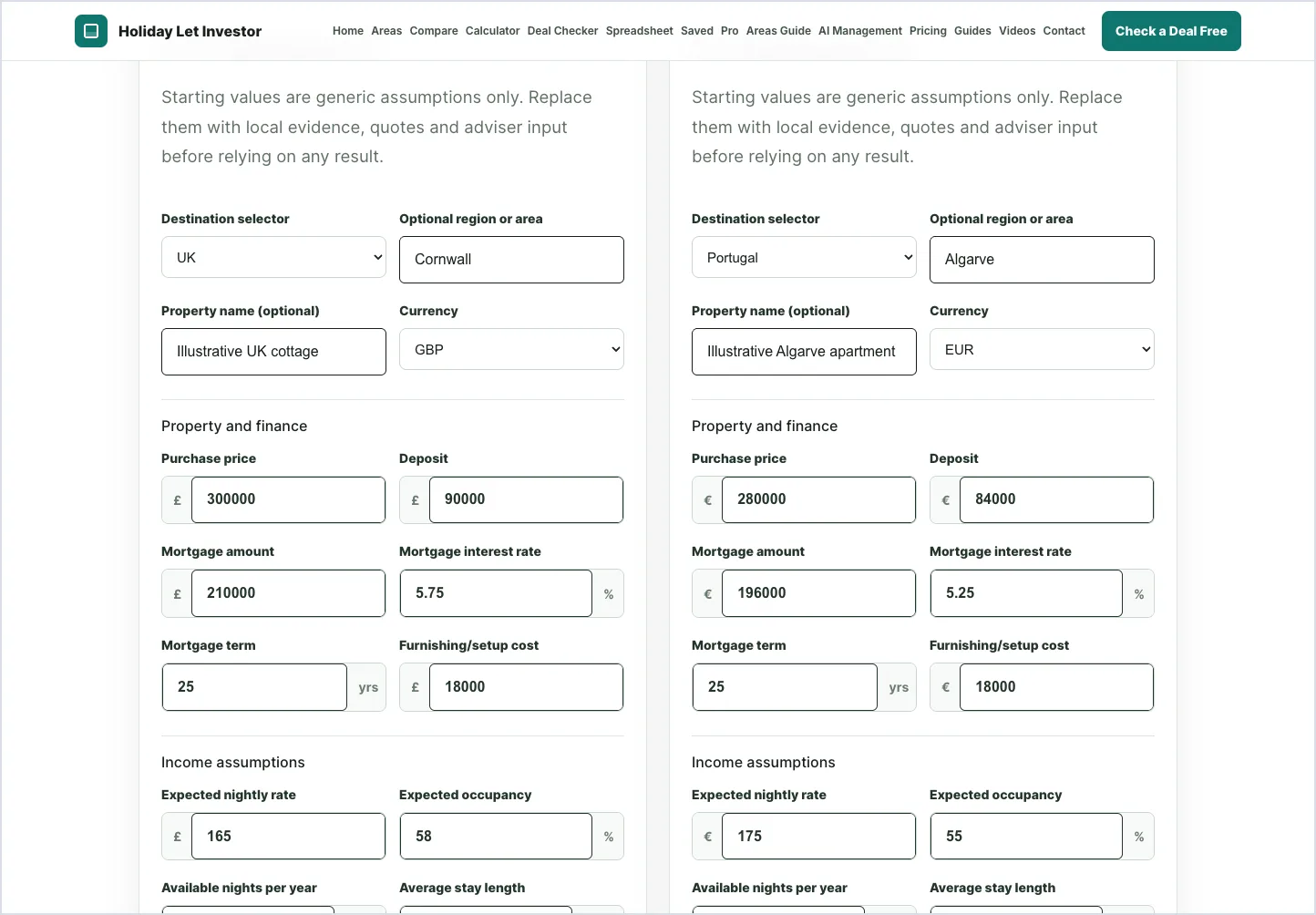
In the article model, Portugal uses 170 booked nights at a blended achieved nightly revenue of EUR 345. Spain uses 195 booked nights at EUR 205. Those are not forecasts. They are illustrative assumptions for a comparison.
Purchase assumptions
The purchase price is not the full capital requirement. A buyer should also include professional costs, setup, maintenance reserve and working capital. The allowances below are placeholders only.
| Purchase comparison | Portugal villa | Spain apartment | Notes |
|---|---|---|---|
| Asking price | EUR 475,000 | EUR 325,000 | Illustrative only |
| 50% deposit | EUR 237,500 | EUR 162,500 | Scenario selected for comparison |
| Illustrative loan amount | EUR 237,500 | EUR 162,500 | 50% loan-to-value on purchase price |
| Transaction/professional allowance | EUR 45,000 | EUR 31,000 | Placeholder only |
| Setup and furnishing reserve | EUR 24,000 | EUR 14,000 | Property-specific |
| Initial maintenance reserve | EUR 16,000 | EUR 10,000 | Higher for villa/pool model |
| Working capital buffer | EUR 15,000 | EUR 12,000 | Supports launch and weaker periods |
| Total modelled capital requirement | EUR 575,000 | EUR 392,000 | Purchase plus illustrative allowances |
At a base exchange rate of EUR 1 = GBP 0.86, the modelled capital requirement is GBP 494,500 for the Portugal example and GBP 337,120 for the Spain example. This is not an exchange-rate forecast.
Running costs
Running costs are where the destinations start to separate. The Portugal villa has pool, garden and maintenance exposure. The Spain apartment has community and building considerations. Both use the same self-managed framework with paid local support.
| Running costs | Portugal villa | Spain apartment | Basis |
|---|---|---|---|
| Gross booking income | EUR 58,650 | EUR 39,975 | Portugal: 170 x EUR 345; Spain: 195 x EUR 205 |
| Local changeover/admin support | EUR 4,692 | EUR 3,198 | 8% of gross |
| Platform and payment fees | EUR 2,346 | EUR 1,599 | 4% of gross |
| Cleaning owner exposure | EUR 3,800 | EUR 2,600 | Net owner exposure after guest charges |
| Pool/garden or community costs | EUR 5,400 | EUR 2,400 | Villa pool/garden vs apartment community |
| Utilities and local services | EUR 5,200 | EUR 3,200 | Seasonal usage allowance |
| Insurance/compliance allowance | EUR 2,200 | EUR 1,500 | Placeholder only |
| Maintenance reserve | EUR 4,106 | EUR 2,399 | Portugal 7% gross; Spain 6% gross |
| Local accounting/admin | EUR 1,600 | EUR 1,400 | Placeholder for support |
| Replacement/contingency reserve | EUR 2,800 | EUR 2,000 | Annual reserve |
| Total operating costs | EUR 32,144 | EUR 20,296 | Sum of costs |
The figures reconcile as follows: Portugal gross income of EUR 58,650 less EUR 32,144 operating costs leaves EUR 26,506 before finance. Spain gross income of EUR 39,975 less EUR 20,296 operating costs leaves EUR 19,679 before finance.
Gross-to-net bridge
Gross income is not investor cashflow. The bridge below moves from headline bookings to net before finance and then to post-finance sensitivity.
| Gross-to-net bridge | Portugal villa | Spain apartment |
|---|---|---|
| Gross booking income | EUR 58,650 | EUR 39,975 |
| Total operating costs | EUR 32,144 | EUR 20,296 |
| Net before finance | EUR 26,506 | EUR 19,679 |
| Base finance cost at 5.75% | EUR 13,656 | EUR 9,344 |
| Illustrative cash after finance | EUR 12,850 | EUR 10,335 |
This does not mean either case is better. Portugal shows a higher post-finance amount, but it also requires more capital, higher villa-specific operating complexity and a different evidence file.
Currency considerations
Currency should be visible because the buyer may think in GBP while the purchase, income and many costs are in EUR.
| FX comparison | Portugal asking price in GBP | Spain asking price in GBP | Portugal net before finance in GBP | Spain net before finance in GBP |
|---|---|---|---|---|
| EUR 1 = GBP 0.82 | GBP 389,500 | GBP 266,500 | GBP 21,735 | GBP 16,137 |
| EUR 1 = GBP 0.86 | GBP 408,500 | GBP 279,500 | GBP 22,795 | GBP 16,924 |
| EUR 1 = GBP 0.90 | GBP 427,500 | GBP 292,500 | GBP 23,855 | GBP 17,711 |
The table does not forecast exchange rates. It shows why a buyer should record the rate used and test alternative reporting rates.
Mortgage assumptions
This article does not recommend any mortgage, lender, rate, term or repayment route. The figures are illustrative sensitivity inputs only.
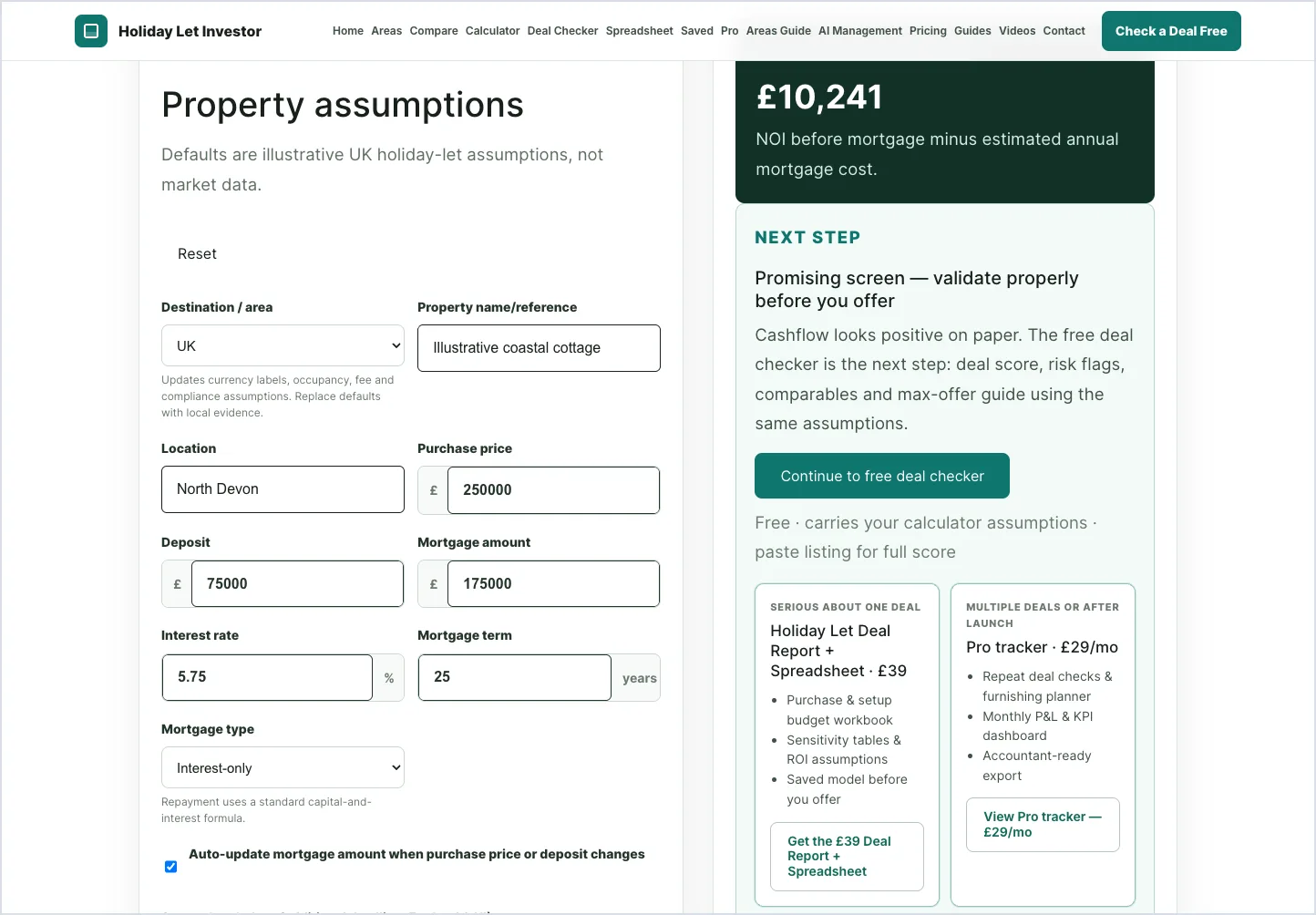
The selected scenario uses a 50% deposit and 50% loan-to-value on the purchase price. The stress table uses interest-only figures only to isolate interest-rate movement. A real buyer would need buyer-specific mortgage advice before relying on any finance assumption.
| Mortgage assumption | Portugal villa | Spain apartment |
|---|---|---|
| Purchase price | EUR 475,000 | EUR 325,000 |
| Deposit percentage | 50% | 50% |
| Illustrative loan amount | EUR 237,500 | EUR 162,500 |
| Base rate input | 5.75% | 5.75% |
| Stress rate input | 6.75% | 6.75% |
| Severe rate input | 7.75% | 7.75% |
| Base annual interest | EUR 13,656 | EUR 9,344 |
| Stress annual interest | EUR 16,031 | EUR 10,969 |
| Severe annual interest | EUR 18,406 | EUR 12,594 |
Stress testing
The stress test changes income, costs and finance. It does not claim either property will perform in this way.
| Stress testing | Portugal villa cash after finance | Spain apartment cash after finance | What it shows |
|---|---|---|---|
| Base case | EUR 12,850 | EUR 10,335 | Both remain positive before buyer-specific tax and exceptional costs |
| Higher finance rate | EUR 10,475 | EUR 8,710 | Lower leverage helps both cases absorb rate movement |
| Lower income case | EUR 6,496 | EUR 5,909 | Seasonality still matters even with lower leverage |
| Lower income plus higher finance | EUR 4,121 | EUR 4,284 | Spain narrows the gap under combined pressure |
| Severe rate using base income | EUR 8,100 | EUR 7,085 | Interest movement reduces but does not eliminate modelled margin |
The comparison should not be reduced to one annual cashflow number. Portugal looks stronger in the base case, while Spain narrows the gap under one combined downside case because the lower capital and cost base changes the pressure points.
Break-even comparison
Break-even occupancy converts finance and fixed-cost pressure into a booking target. This simplified method divides fixed and semi-fixed annual cash costs plus finance by achieved nightly revenue after income-linked cost percentages.
| Break-even comparison | Portugal villa | Spain apartment |
|---|---|---|
| Base booked nights assumption | 170 nights | 195 nights |
| Average achieved nightly revenue | EUR 345 | EUR 205 |
| Income-linked cost allowance | 19% | 18% |
| Base finance-cost break-even nights | 124 nights | 134 nights |
| Base finance-cost break-even occupancy | 34.0% | 36.6% |
| Stress finance-cost break-even nights | 133 nights | 143 nights |
| Stress finance-cost break-even occupancy | 36.3% | 39.2% |
The Spain apartment needs more booked nights because the nightly revenue assumption is lower. The Portugal villa needs fewer nights but has a higher capital requirement and higher villa-specific operating risk. The conclusion is that the buyer should compare risk categories, not just cashflow lines.
Evidence matrix
The evidence matrix is where the comparison becomes investable. The stronger destination for analysis is the one with clearer evidence.
| Evidence matrix | Portugal evidence needed | Spain evidence needed | Confidence rule |
|---|---|---|---|
| Local permission/rules | Local accommodation or short-let position, municipality notes, adviser confirmation | Tourist-let licence/rules, regional and municipality checks, community rules | Do not rely on a forecast without rule evidence |
| Demand | Comparable villas, golf/resort demand, peak and shoulder season by month | Comparable apartments/villas, resort maturity, winter demand evidence | Use monthly evidence, not only annual income |
| Management | Cleaner, pool/garden, maintenance, guest support | Cleaner, key handover, building/community process, maintenance | Written scope beats verbal estimates |
| Costs | Pool, garden, utilities, maintenance and contingency | Community fees, building costs, utilities and maintenance | Replace placeholders before offer |
| Currency | EUR purchase, EUR income/costs, GBP reporting | EUR purchase, EUR income/costs, GBP reporting | Record base and stress FX rate |
| Finance | Buyer-specific overseas finance terms | Buyer-specific overseas finance terms | Do not compare mortgage cost with gross income |
| Ownership structure | Local professional ownership and tax questions | Local professional ownership and tax/community questions | Obtain qualified advice |
| Exit/resale | Comparable villa resale evidence | Comparable apartment/resort resale evidence | Do not assume capital growth |
Decision framework
The decision framework turns preferences into questions.
| Decision framework | Portugal may be more useful to analyse first when… | Spain may be more useful to analyse first when… |
|---|---|---|
| Property preference | The buyer wants villa, pool, garden or golf/resort exposure | The buyer wants apartment, resort, marina or community facilities |
| Management preference | The buyer can coordinate paid local villa support | The buyer can work within community/building systems |
| Capital | The buyer can model higher purchase and setup capital | The buyer wants a lower modelled capital requirement |
| Evidence quality | Comparable villa, local rules and manager evidence are strong | Community rules, licence evidence and comparable apartment data are strong |
| Seasonality | Shoulder-season villa demand can be evidenced | Winter or longer-season resort demand can be evidenced |
| Operating risk | Pool, garden and remote maintenance risks are acceptable | Community and building-rule risks are acceptable |
This framework does not recommend either destination. It helps decide which opportunity deserves deeper analysis first.
Professional questions before offer
Before an offer, a buyer should ask qualified professionals about local letting rules, licence or tourist-use position, ownership structure, buyer-specific legal implications, tax treatment, mortgage availability, planning, community rules, insurance, currency and local operating obligations.
The role of Holiday Let Investor is to organise the questions and model the assumptions. It does not replace professional advice.
Holiday Let Investor workflow
| Workflow stage | What to do | Relevant tool |
|---|---|---|
| Research | Compare destination story, property type and buyer fit | Areas |
| Area context | Review Portugal and Spain separately | Portugal Area and Spain Area |
| Initial model | Enter purchase, income, costs and finance assumptions | Holiday Let Calculator |
| Evidence review | Record what is verified and missing | Deal Checker |
| Side-by-side comparison | Compare Portugal, Spain and UK examples consistently | Investment Comparison Engine |
| Buyer file | Save assumptions, evidence and questions | Property Report |
| Spreadsheet model | Keep the full working model and sensitivity rows | Holiday Let Investment Spreadsheet |
| Ongoing research | Manage multiple opportunities | Pro |
| Evidence intelligence | Challenge weak assumptions and missing evidence | AI Investment Intelligence |



Related investor notes
For a single-destination overseas example, read the Portugal Villa Investment Case Study. For worked-example structure, review the GBP 325,000 Cornwall holiday let analysis. If the forecast is agent-led, use the Agent Income Forecast Checklist. If finance sensitivity is central, read the Holiday Let Mortgage Stress Test. For a UK regional comparison, see Cornwall vs Devon Holiday Let Investment. You can also browse Investor Notes and Videos.
FAQs
Is Portugal or Spain better for holiday-let investment?
This article does not recommend one country over the other. Compare property type, local rules, evidence quality, management, currency, capital, seasonality and stress testing.
Can buying property in Portugal or Spain give residency, citizenship or an EU passport?
Property ownership alone does not provide Portuguese or Spanish citizenship, EU passport rights, residency or immigration status. Residency and citizenship rules change over time. Anyone considering immigration should obtain specialist advice. This article does not provide immigration advice.
Should I compare a Portugal villa with a Spain apartment?
It can be useful if the buyer is deciding where to analyse first, but the comparison must make the different operating models clear. A villa and an apartment can have different costs, evidence requirements, community rules, management needs and guest profiles.
How should currency be modelled?
Record the exchange rate used for the decision file, then test alternative rates. Currency movement can change the reported purchase cost, income, running costs and cashflow when the buyer is thinking in GBP and the property operates in EUR.
What evidence should be checked before making an offer?
Request local rules, registration or tourist-let position, community rules, comparable booking data, seasonality, management scope, running-cost evidence, finance assumptions, insurance and professional advice.
How does Holiday Let Investor help compare Portugal and Spain?
Use Areas for research, the Calculator for assumptions, Deal Checker for evidence gaps, the Investment Comparison Engine for side-by-side modelling, the Spreadsheet and Property Report for the buyer file, and Pro plus AI Investment Intelligence for ongoing evidence review.
Summary
Portugal and Spain can both be credible areas to analyse, but destination appeal is only the opening question. Portugal may create a villa-led model with higher capital and pool/garden costs. Spain may create an apartment-led model with lower capital and community costs. Neither is automatically better.
The disciplined approach is to use one scenario framework, compare the assumptions, stress-test the numbers and then ask whether the evidence is strong enough to justify the next step.
Conclusion
The strongest Portugal vs Spain analysis is not the one with the most attractive scenery or the highest income line. It is the one where the buyer can explain the property type, evidence quality, management route, costs, currency exposure, finance sensitivity and break-even pressure.
Start with research. Run the numbers in the Holiday Let Calculator. Record evidence gaps in Deal Checker. Compare both destinations in the Investment Comparison Engine. Save the buyer file in a Property Report or the Holiday Let Investment Spreadsheet. Use Pro and AI Investment Intelligence when you need to manage multiple opportunities and challenge weak assumptions.
Do not choose a destination because it feels easier. Analyse the evidence first.