Holiday Let Mortgage Stress Test: How Rising Interest Rates Can Completely Change an Investment
Important note
This article is educational only. It is not mortgage, financial, investment, tax, legal, planning, valuation or insurance advice. The figures below are illustrative assumptions used to show a modelling method. They are not a prediction, forecast or recommendation. Buyers should confirm borrowing capacity, product terms, fees, tax treatment, legal position, planning position, insurance and property-specific risks with suitably qualified professionals before relying on any model.
Introduction
A holiday let can look attractive before finance is added. The income forecast may appear strong, the gross yield may look acceptable and the location may have visible demand. But the investment can change quickly when the mortgage cost is stressed.
That is why a holiday let mortgage stress test belongs near the beginning of the buyer workflow. A small movement in rate, a different repayment route, a lender fee, a launch delay or a lower-than-expected occupancy level can move a property from apparently comfortable to highly sensitive.
The aim is not to avoid financed purchases. It is to know how much forecast cashflow is genuinely available after operating costs and debt service, and how much depends on the best case happening.
This guide follows the Holiday Let Investor workflow:
Research -> Holiday Let Calculator -> Deal Checker -> Investment Comparison Engine -> Property Report / Holiday Let Investment Spreadsheet -> Pro -> AI Investment Intelligence.
It is a worked modelling framework, not a mortgage recommendation.
Key takeaways
- Mortgage stress testing shows how sensitive a holiday-let model is to finance cost, repayment route and refinance risk.
- The headline income figure is not enough. The key number is cashflow after operating costs and finance.
- Interest-only and repayment assumptions should be modelled separately because they can produce very different cashflow outcomes.
- Break-even occupancy rises when finance cost rises, even if the property, nightly rate and operating costs stay the same.
- A realistic stress test combines higher finance cost with weaker income, not one variable in isolation.
- The offer decision should reflect evidence quality, downside sensitivity and cash reserve pressure.
- Holiday Let Investor tools help turn mortgage assumptions into a structured decision file, but they do not replace professional mortgage advice.
Watch the full walkthrough
Why Mortgage Stress Testing Matters for Holiday Lets
Mortgage stress testing matters because holiday-let income is variable. Bookings are seasonal, rates change by month, maintenance can be uneven and launch periods can be slower than expected. If the model only works at one optimistic income level and one low finance cost, the buyer may not have a robust decision.
The stress test asks a narrower question: how much pressure can this property absorb before the numbers stop making sense?
For holiday lets, the answer is often hidden by gross income. A property with an illustrative £46,000 gross booking forecast may sound strong, but that figure is not net operating income. Management, platform charges, cleaning exposure, utilities, maintenance, insurance, local running costs and contingency need to be deducted before finance is considered.
Only after that bridge is complete can the mortgage line be tested. If net before finance is £19,150 and the interest-only cost is £16,172, there is only £2,978 left before owner tax, capital items and unplanned costs. A 1 percentage point rate increase can reduce that to almost nothing.
Run the first finance model
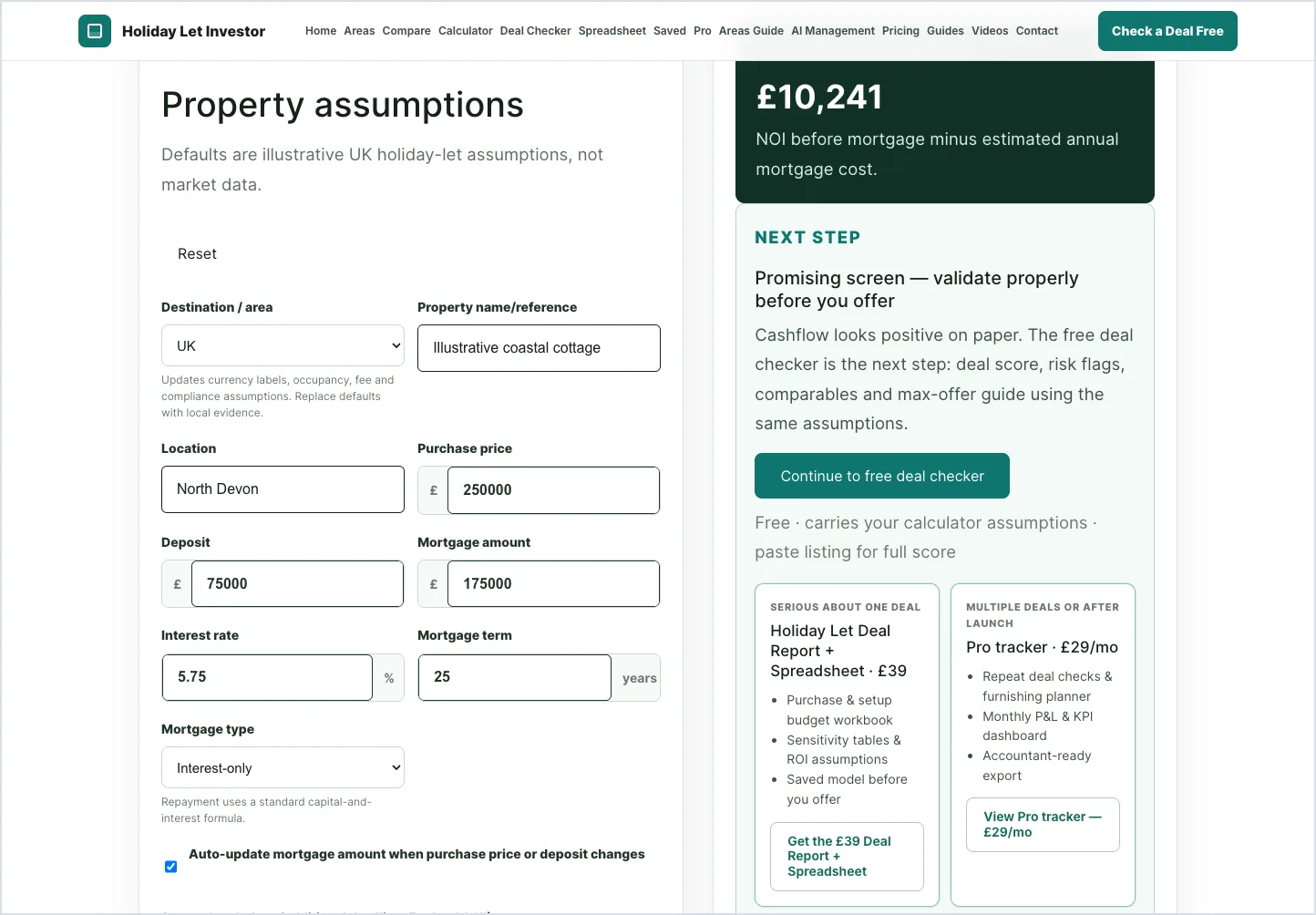
Use the Holiday Let Calculator to turn purchase price, deposit, finance cost, income and running costs into one structured model. Treat the output as an assumption test, not a return forecast.
Inputs Needed Before You Run the Model
The quality of a stress test depends on the quality of the inputs. If the purchase price, loan amount, operating costs or income forecast are unsupported, the output should be labelled as low-confidence.
| Input | Why it matters | Evidence to request |
|---|---|---|
| Purchase price | Sets the capital base and loan requirement | Asking price, offer target, stamp duty and acquisition cost assumptions checked separately |
| Deposit | Determines the approximate loan size | Available funds, lender criteria and cash reserve position checked externally |
| Loan amount | Drives annual debt-service cost | Indicative borrowing capacity from a qualified mortgage professional |
| Interest rate | Controls finance sensitivity | Product illustration, broker estimate or conservative scenario input |
| Repayment route | Changes cashflow profile | Interest-only and repayment modelled separately |
| Term | Affects repayment calculation | Confirmed with mortgage professional |
| Fees | Can change upfront and annual cost | Lender, broker, valuation and legal cost assumptions checked separately |
| Cash reserve | Determines resilience to weak periods | Buyer-specific reserve plan and professional advice where required |
The model should also include operating assumptions. It is not meaningful if management fees, platform costs, cleaning costs, utilities and maintenance reserves are missing.
Interest-Only vs Repayment Assumptions
Interest-only and repayment are not interchangeable in a cashflow model. This article does not recommend either route. It shows why both should be modelled where relevant, because each route places different pressure on annual cashflow.
Interest-only modelling shows the annual interest cost on the debt. Repayment modelling includes interest and capital repayment, which can materially reduce cashflow available after finance.
Here is the illustrative purchase scenario used throughout this article.
| Mortgage input | Illustrative assumption |
|---|---|
| Purchase price | £375,000 |
| Deposit | £93,750 |
| Loan amount | £281,250 |
| Loan-to-value used in model | 75% |
| Base interest-rate assumption | 5.75% |
| Higher-rate scenario | 6.75% |
| Severe-rate scenario | 7.75% |
| Repayment term used for comparison | 25 years |
| Gross booking income assumption | £46,000 |
| Available nights | 365 |
| Blended achieved nightly revenue | £185 |
All figures in this table are illustrative assumptions. Replace them with verified property, lender and professional inputs before making any decision.
The annual finance cost changes materially depending on route.
| Scenario | Interest-only annual cost | Illustrative repayment annual payment | Difference versus interest-only |
|---|---|---|---|
| Base rate: 5.75% | £16,172 | £21,232 | £5,060 |
| Higher rate: 6.75% | £18,984 | £23,318 | £4,334 |
| Severe rate: 7.75% | £21,797 | £25,492 | £3,695 |
The repayment figures are illustrative estimates using the stated loan amount and 25-year term. They are not a mortgage quote and do not include all possible fees, lender conditions or buyer-specific circumstances.
Rate Sensitivity and Refinance Risk
Rate sensitivity is the effect of changing the interest-rate assumption while keeping the rest of the model constant. It is a simple test, but it is often the test that exposes weak deals.
Using the illustrative loan amount of £281,250, each 1 percentage point rate movement adds about £2,812 of annual interest cost. That is £234 per month before considering any other changes.
| Interest-rate scenario | Annual interest cost | Monthly equivalent | Change from base |
|---|---|---|---|
| 5.75% base case | £16,172 | £1,348 | – |
| 6.75% higher-rate case | £18,984 | £1,582 | +£2,812 per year |
| 7.75% severe-rate case | £21,797 | £1,816 | +£5,625 per year |
The risk is not only the starting rate. A buyer also needs to consider product-end assumptions, refinance assumptions, fees and whether the property would still be acceptable if income is weaker at the same time.
This article does not advise on mortgage products or lender selection. It only shows why the finance assumption should be stressed.
Compare finance scenarios
Use the Investment Comparison Engine to compare a financed holiday-let case against an alternative property, lower-debt scenario or different area. The comparison is useful only if the assumptions are consistent across both options.
Gross-to-Net Cashflow Bridge
The mortgage stress test should sit underneath a gross-to-net bridge. Without that bridge, the buyer is testing the wrong number. In this illustrative model, forecast gross bookings of £46,000 reduce to £19,150 before finance.
| Cashflow line | Illustrative annual amount |
|---|---|
| Gross booking income | £46,000 |
| Management fee allowance | -£9,200 |
| Platform and payment fees | -£1,380 |
| Cleaning and laundry net exposure | -£3,600 |
| Utilities and broadband | -£3,900 |
| Repairs and maintenance reserve | -£3,800 |
| Insurance, safety checks and admin | -£1,800 |
| Local operating/admin allowance | -£1,000 |
| Contingency | -£2,170 |
| Total operating costs | -£26,850 |
| Net before finance | £19,150 |
The finance line is not being deducted from £46,000. It is being deducted from £19,150. That is why a property can look strong at gross-income level and weak after debt service.
Post-Finance Cashflow
Once net before finance is calculated, the buyer can test post-finance cashflow.
| Scenario | Net before finance | Finance cost | Illustrative post-finance cashflow |
|---|---|---|---|
| Interest-only at 5.75% | £19,150 | £16,172 | £2,978 |
| Interest-only at 6.75% | £19,150 | £18,984 | £166 |
| Interest-only at 7.75% | £19,150 | £21,797 | -£2,647 |
| Repayment at 5.75% | £19,150 | £21,232 | -£2,082 |
The table does not include owner tax, personal cash needs, capital replacement, unexpected repairs, legal fees, purchase costs or future refinancing costs. It is deliberately narrow: operating cashflow after the modelled finance line.
The key lesson is sensitivity. Under the base interest-only assumption, the model has limited surplus. Under a 1 percentage point increase, the annual surplus is almost eliminated. Under a 2 percentage point increase, the model is negative before other owner-specific costs.
Break-Even Occupancy After Finance
Break-even occupancy is the occupancy level required for the property to cover operating costs and the modelled finance cost. It translates finance pressure into bookings pressure.
The simplified formula used here is:
Required gross income = operating costs + finance cost
Break-even occupancy = required gross income / (available nights x blended achieved nightly revenue)
Using the illustrative assumptions:
- Available nights: 365
- Blended achieved nightly revenue: £185
- Maximum gross income at 100% occupancy: £67,525
| Scenario | Required gross income | Break-even occupancy |
|---|---|---|
| Interest-only at 5.75% | £43,022 | 63.7% |
| Interest-only at 6.75% | £45,834 | 67.9% |
| Interest-only at 7.75% | £48,647 | 72.0% |
| Repayment at 5.75% | £48,082 | 71.2% |
This is the break-even occupancy before owner tax, capital items and personal cash requirements. A buyer may want a larger margin of safety than break-even, but that threshold is buyer-specific and should not be inferred from this article.
Finance cost changes the booking target. If the property would need over 70% occupancy just to cover the modelled operating and finance lines, the buyer needs strong evidence that this is realistic for the exact property and area.
Combining Lower Income With Higher Debt Cost
A useful stress test changes more than one variable. The stronger question is what happens when higher finance cost and lower income occur together.
The following downside case uses:
- Gross booking income reduced from £46,000 to £39,000
- Operating costs increased from £26,850 to £27,600
- Interest-only finance cost stressed at 7.75%
- Same loan amount of £281,250
- Same blended achieved nightly revenue of £185
| Downside case line | Illustrative amount |
|---|---|
| Gross booking income | £39,000 |
| Operating costs | -£27,600 |
| Net before finance | £11,400 |
| Interest-only finance cost at 7.75% | -£21,797 |
| Illustrative post-finance cashflow | -£10,397 |
| Required gross income to break even | £49,397 |
| Break-even occupancy at £185/night | 73.2% |
This is not a prediction. It is a pressure test to show whether the offer price, evidence requirement or priority level needs to change.
Check the risk before making an offer
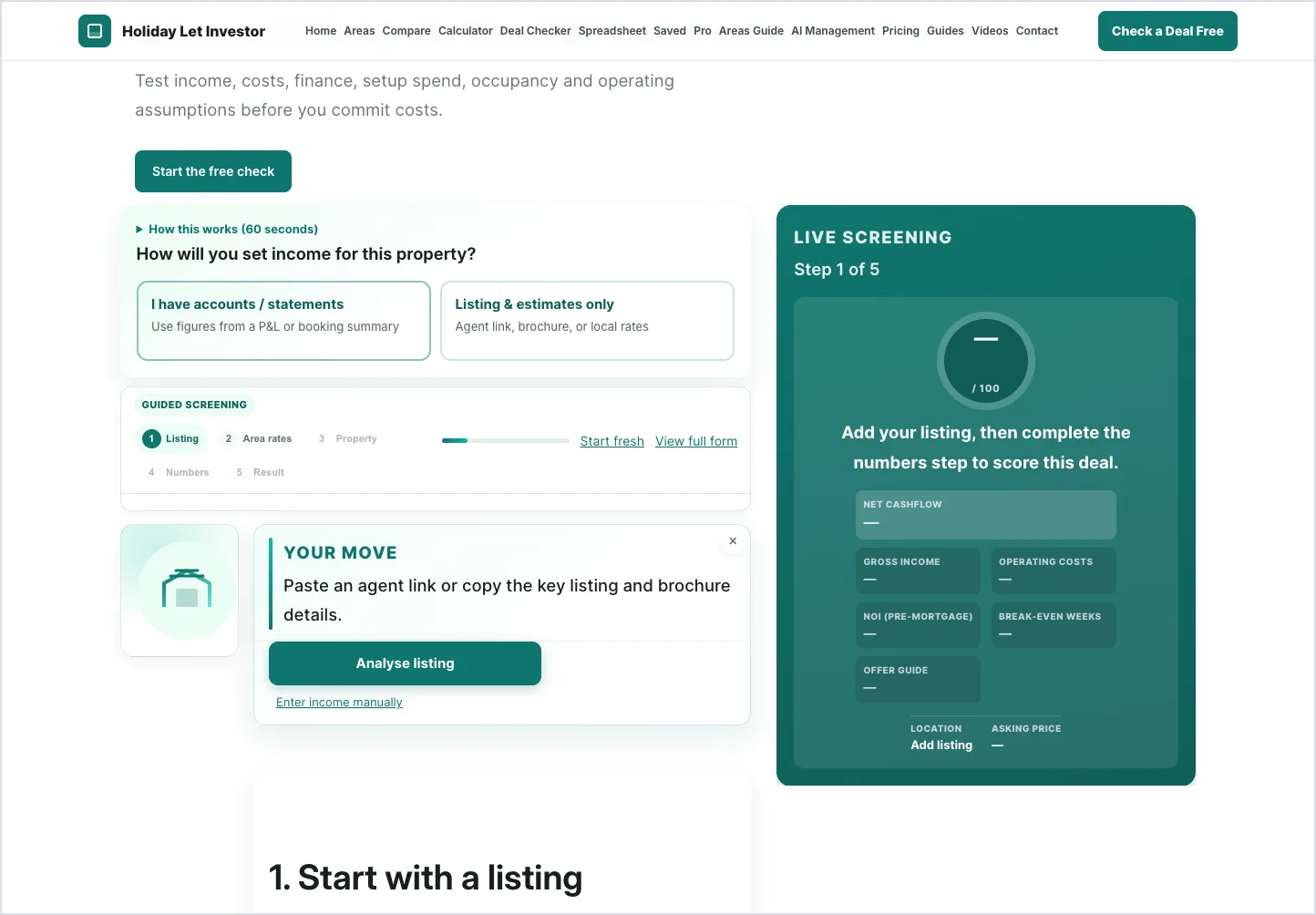
Use the Deal Checker when a property looks attractive but the finance sensitivity is tight. Record the assumptions, evidence gaps and questions before treating the deal as offer-ready.
Evidence Matrix for the Mortgage Stress Test
A mortgage stress test should not rely only on arithmetic. It should also assess whether the inputs are supported.
| Assumption | Strong evidence | Weak evidence | Risk if unsupported |
|---|---|---|---|
| Gross income | Same-property booking history or high-quality comparable evidence | Verbal forecast only | Income may be overstated |
| Achieved nightly revenue | Monthly achieved rate data | Advertised peak rates | Break-even occupancy may be understated |
| Management costs | Written manager proposal | Generic percentage | Net cashflow may be overstated |
| Cleaning costs | Local quote or existing history | Assumed per-stay cost | High turnover may reduce net income |
| Maintenance reserve | Property-condition evidence | No reserve | Repairs may absorb cashflow |
| Interest rate | Professional lending input | Unchecked web assumption | Finance cost may be wrong |
| Repayment route | Confirmed affordability and product discussion | Modelled casually | Cashflow route may be unrealistic |
| Refinance assumption | Conservative scenario notes | Assumes future rate improvement | Model may depend on a favourable future event |
| Cash reserve | Buyer-specific reserve plan | No reserve shown | Weak season or repair event may create pressure |
This separates a weak deal from a weak evidence file. Sometimes the opportunity is not necessarily poor, but the buyer does not yet have enough evidence to rely on the numbers.
Questions Before Making an Offer
Before making an offer on a financed holiday-let opportunity, use these questions to pressure-test the model.
| Question | Why it matters |
|---|---|
| What happens if the interest-rate assumption is 1 percentage point higher? | Tests whether the margin is already too thin |
| What happens if the rate is 2 percentage points higher? | Shows severe sensitivity before offer |
| Does the model work on repayment as well as interest-only? | Separates product-route sensitivity from property strength |
| What occupancy is needed after finance? | Turns cashflow pressure into a booking target |
| Is the required occupancy realistic for the area and property type? | Connects finance modelling to market evidence |
| What if income is lower and finance cost is higher at the same time? | Tests combined downside pressure |
| Are fees, repairs, utilities and reserves included? | Prevents gross income from hiding missing costs |
| Has a qualified mortgage professional reviewed the lending assumption? | Avoids relying on unverified borrowing assumptions |
| Is the offer price still sensible under the stress case? | Links the model back to negotiation risk |
The answer may be: proceed only after more evidence; reduce the offer; compare another property; increase cash reserve; or step away. Holiday Let Investor tools can structure that decision, but professional input is still required where relevant.
How the Holiday Let Investor Tools Fit Together
The mortgage stress test should connect to research, deal screening, comparison and records.
| Workflow stage | Tool | Role in the mortgage stress test |
|---|---|---|
| Research | Investor Notes | Keep the worked example, assumptions and evidence logic in one place |
| Calculator | Holiday Let Calculator | Model income, operating costs, finance and break-even occupancy |
| Deal screening | Deal Checker | Flag unsupported finance assumptions, tight margins and evidence gaps |
| Comparison | Investment Comparison Engine | Compare alternative properties, areas or debt levels on consistent assumptions |
| Decision record | Property Report | Document the base case, stress case, evidence notes and questions before offer |
| Spreadsheet | Holiday Let Investment Spreadsheet | Build a detailed scenario model for repeat testing |
| Workspace | Pro | Track multiple opportunities, saved assumptions and follow-up actions |
| Evidence review | AI Investment Intelligence | Review saved assumptions and identify missing evidence; it supports judgement but does not replace professional advice |
Save the decision file
Use the Property Report or Holiday Let Investment Spreadsheet to record the base case, stress case, evidence notes and open questions. Use Pro and AI Investment Intelligence if you are tracking multiple opportunities.



Common Modelling Mistakes
| Mistake | Better modelling check |
|---|---|
| Testing finance cost against gross bookings | Build the gross-to-net bridge first |
| Using only one interest-rate assumption | Show base, higher-rate and severe-rate cases |
| Hiding the repayment route | Model interest-only and repayment separately where relevant |
| Ignoring break-even occupancy | Convert finance pressure into a required booking level |
| Leaving the stress test outside the offer decision | Use the downside case to decide whether evidence, price or priority needs to change |
FAQ
How do I stress-test a holiday-let mortgage?
Start with purchase price, deposit, loan amount, interest-rate assumption, repayment route and term. Build a gross-to-net bridge, deduct finance cost, then model higher-rate and lower-income scenarios. The output should show post-finance cashflow and break-even occupancy.
What interest rate should I use in a holiday-let model?
This article cannot tell you what rate to use. Rates, eligibility, fees and product terms depend on the buyer, lender and property. Use verified professional input where possible, then add higher-rate scenarios.
How does mortgage cost affect break-even occupancy?
Mortgage cost increases the gross income required to break even. If operating costs are £26,850 and finance cost is £16,172, the required gross income is £43,022. If finance cost rises to £21,797, the required gross income rises to £48,647 before owner-specific costs.
Should I model interest-only and repayment separately?
Yes, if both routes are relevant. Interest-only and repayment can produce different annual cashflow outcomes. This is modelling education, not a recommendation for either route.
What happens if occupancy falls and rates rise at the same time?
The model can deteriorate quickly because income reduces while finance cost increases. In the illustrative downside case in this article, gross income falls to £39,000, operating costs rise to £27,600, and stressed interest cost is £21,797. The resulting post-finance cashflow is negative before wider owner-specific costs.
Is this mortgage advice?
No. This article is an educational modelling framework. It does not recommend a lender, product, rate, repayment route, loan size or purchase decision. Buyers should use qualified professionals for mortgage, tax, legal, planning, valuation and insurance matters.
Conclusion
A holiday-let mortgage stress test is not about predicting the future. It is about understanding the pressure points before a buyer commits more time, money and attention to a property.
The headline question is not "does the deal work at the best case?" It is "what happens when finance cost rises, income softens and operating costs are complete?"
Use the Holiday Let Calculator for the first model, the Deal Checker for offer-stage risk, the Investment Comparison Engine for alternatives, and the Property Report or Holiday Let Investment Spreadsheet to save the evidence. If you are comparing multiple opportunities, Pro and AI Investment Intelligence can help keep the assumptions, evidence gaps and next questions organised.
For related worked examples, see the £325,000 Cornwall holiday-let analysis and the Agent Income Forecast Checklist.
The strongest model is not the one with the highest forecast. It is the one where the assumptions are explicit, the downside is visible and the buyer knows what still needs to be verified before an offer.